Multi-Outlet Rostering for SG F&B: Save Time & Labour Cost
Multi-outlet F&B in Singapore is a different game from running one site. You hold a separate SFA licence for every outlet. You can't freely move staff between sites — each premise has its own licence and licensing hours. And the resident pool you can actually hire is capped by a hard quota. Yet most multi-outlet operators still schedule each location by hand, in separate spreadsheets, with no cross-outlet view.
The result? Double-booked staff, idle hours at one outlet while another is short, and a labour bill that creeps past 30% of revenue before anyone notices.
This post is a practical walkthrough of how a local multi-outlet operator streamlines rostering across sites — one staff pool, conflict-proof scheduling, licence-aware shifts — and what it saves in time and cost.
The multi-outlet reality in Singapore
Before the fix, the constraints that make multi-outlet scheduling genuinely hard:
Every outlet is separately licenced. A 5-outlet chain holds 5 SFA Food Shop licences (S$195/yr each) or Food Stall licences (S$32/yr) — the licence is tied to the premises, not the brand. Liquor licences are per-premises and non-transferable, and each licensed premise has its own licensing hours.
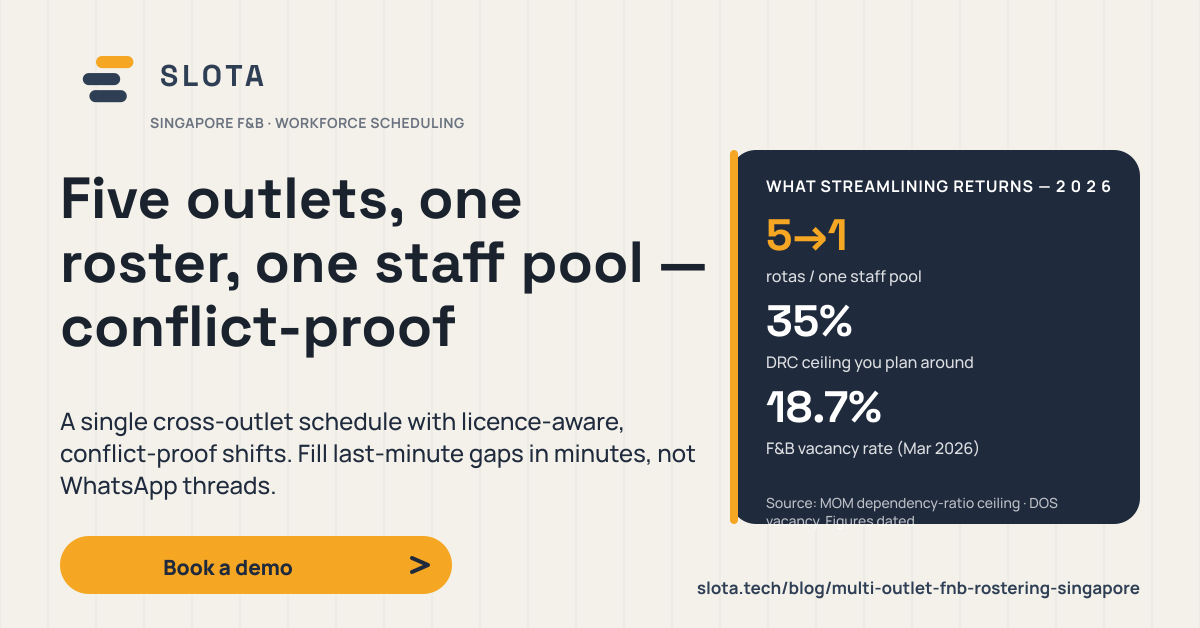
The resident pool is capped. The services-sector dependency-ratio ceiling is 35% of your workforce, and resident entrants into F&B are falling — from 16,100 in 2023 to about 14,000 in 2025. You can't just hire more people for peak. Growth outlets have to be staffed by reallocating the same resident pool across your sites. Cross-outlet shifts aren't a nice-to-have; they're the only lever.
Each manager builds their own roster. Five outlets, five spreadsheets, five versions of "who's working where." No cross-outlet view, no shared hours budget, no way to see a double-booking until it happens.
The cross-outlet fix: one staff pool, conflict-proof
The shift is from "every outlet plans its own week" to "one roster, one staff pool, across all your sites." Here's what that looks like in practice.
One view of every shift, everywhere. Instead of five managers each guessing, you see the whole picture in one place: who's scheduled at each outlet, what each shift requires, and where there's slack you can redeploy.
Licence- and credential-aware shifts. Because every outlet holds its own SFA or liquor licence, a cross-outlet tool that doesn't know that will happily schedule a swap that the law or the licence forbids. The right system respects which outlet a shift belongs to and what credential that outlet's shifts require.
Conflict-proof scheduling. When you move people between outlets, the failure mode is double-booking: the same staffer scheduled at outlet A and outlet B at the same time. A conflict guard checks before any shift is reassigned — for offers, swaps and bookings — and refuses the move with a clear reason instead of silently creating an overlap. Back-to-back shifts are fine; overlaps are not.
Filling last-minute gaps in minutes, not WhatsApp threads
Here's the high-frequency pain every multi-outlet operator knows: it's Friday night, the phone rings, someone can't make it. In a chronic-shortage market — F&B job vacancy rate was 18.7% in March 2026 — no-shows and sick calls are routine, not exceptions.
With a cross-outlet roster, filling the gap is a lookup, not a scramble: who's available, credentialed, and not already double-booked? You pull a trained staffer from outlet A to cover outlet B in minutes, with the system checking the licence and the overlap for you.
Hours budgeting: keep labour % in check per outlet
With labour at 25–35% of revenue, the weekly roster is your P&L lever. A streamlined system gives you per-outlet hours vs. sales, and alerts you when a shift — or an outlet's whole week — is heading over budget before payroll runs. At S$2,220 a month per PWM-covered worker, an overstaffed shift isn't a small leak; it's a line item.
And because PWM hours, overtime at 1.5× beyond 44 hours, and per-licence shifts all carry regulatory weight, the same roster doubles as your MOM-compliance surface — checked at scheduling time, not after the fact.
What it actually saves
Put it together and the savings are concrete:
- Admin time. Five managers building five rosters becomes one owner of one roster. Weekly scheduling drops from hours to minutes.
- Labour cost. Tighter per-outlet hours budgeting keeps labour % inside the 25–35% band instead of creeping past it.
- Coverage. Last-minute gaps filled fast from your own pool — no premium agency fill, no overworked remaining staff.
- Compliance. PWM hours, OT and per-licence shifts checked before payroll, not flagged after.
When wages, levy and CPF are fixed, this is the lever that absorbs them: schedule the right hours, at the right outlet, against real demand, with the right people.
Your next step
If you're running three, five or ten outlets on separate spreadsheets, you're leaving hours and money on the table every week.
See the cross-outlet roster in action — one staff pool, conflict-proof scheduling, licence-aware shifts, and per-outlet labour budgeting — on your own outlets.
Make the roster the lever, not the leak.
Conflict-proof, PWM-aware rostering across every outlet — set up in minutes.
Get started freeNo credit card · No setup fee