Singapore F&B Labour Costs 2026: Why Manual Rostering Breaks
Every Singapore F&B owner knows the rhythm by now: the wage floor goes up every 1 July, the foreign-worker quota is capped, and the roster you publish on Sunday night is the only number you actually control.
Here's the problem. The 2026 cost stack — a higher Progressive Wage Model (PWM) floor, a hard dependency-ratio ceiling, and employer CPF — doesn't just raise your bill. It quietly breaks the manual, per-outlet rostering that most multi-location operators still run on Excel and WhatsApp. When every hour you schedule is more expensive and harder to fill, the spreadsheet that used to "work" stops working.
This post walks through exactly how that happens, with the numbers, and why the fix is scheduling — not more sales.
The cost stack keeps climbing — and none of it is in your control
Let's put the 2026 numbers on the table.
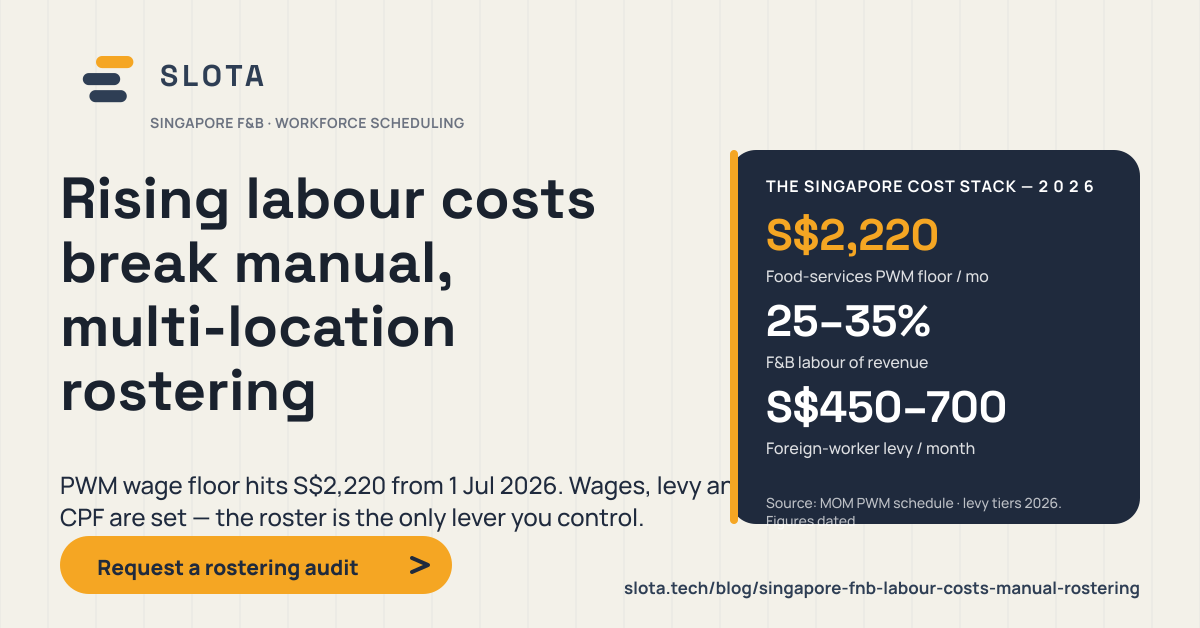
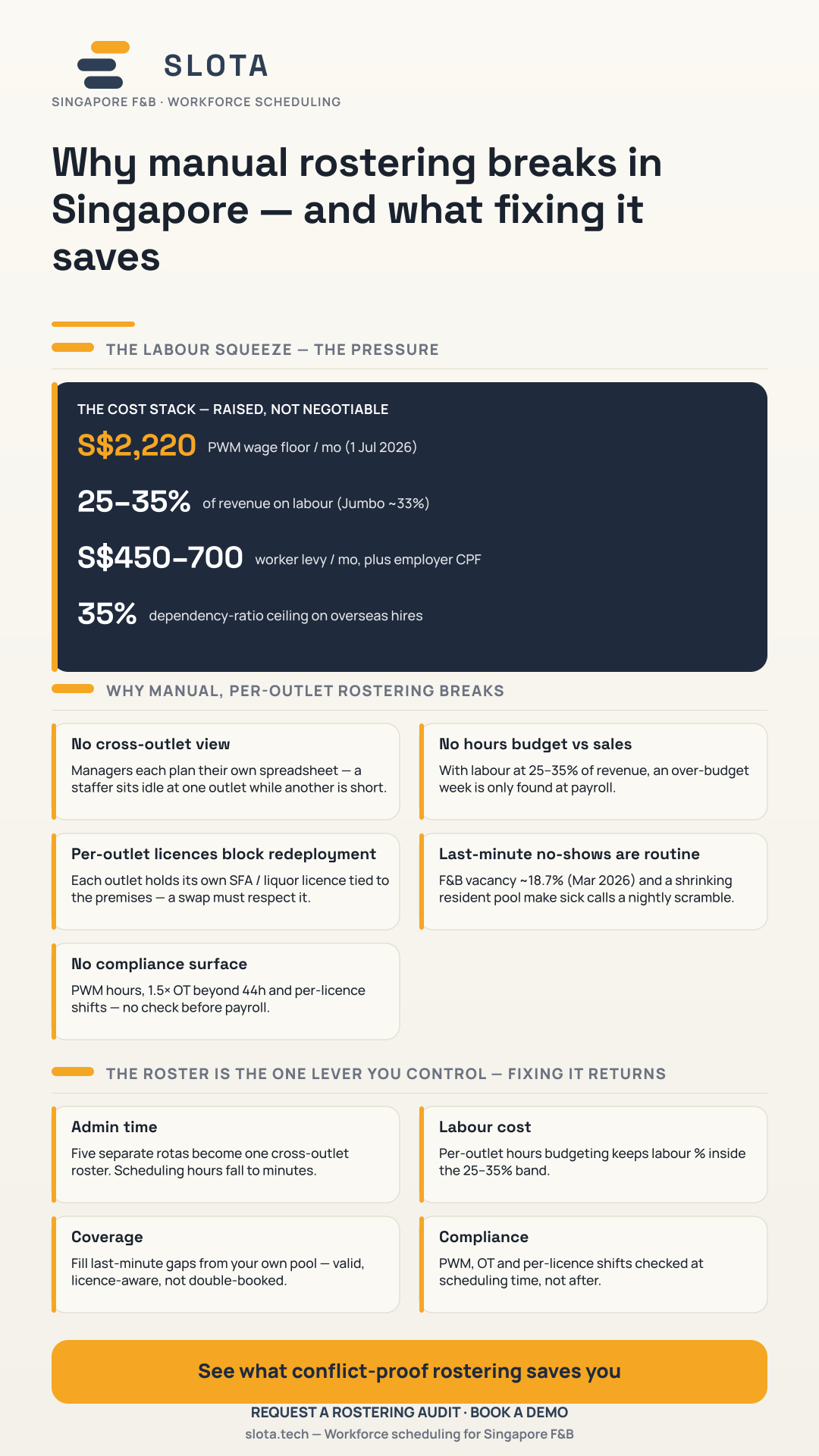
The wage floor is now S$2,220. The entry-level quarterly minimum monthly gross wage for Food Services PWM rises to S$2,220 from 1 July 2026, up from roughly S$2,000 in 2024. It applies to every Singaporean and PR food-services worker in an SFA-licenced premise at a firm that hires foreign workers — and the floor is a condition for obtaining or renewing work passes. You don't negotiate it; you budget around it.
Labour is already a third of revenue. Across Singapore F&B, labour typically runs 25–35% of revenue, and even Jumbo Group — an SGX-listed seafood group with real scale — ran about 33% of revenue in FY2024, near the top of the healthy band. Median full-time resident F&B wages rose to S$2,616 in 2024, up 4.6% from S$2,500 in 2022. Every 1 July step pushes that percentage higher unless you cut hours.
Foreign labour isn't cheap at the margin. Under the services-sector Work Permit regime, the dependency-ratio ceiling is 35% of your workforce, and each foreign worker costs S$450–700 a month in levy on top of their wage (S$650 flat for an S-Pass since September 2025). Add employer CPF of 17% on your local hires and you have a cost stack where the wage is only part of the story.
The key point: wages, levy and CPF are legislated and scheduled. You don't control them. The only thing you control is how many hours you schedule, against each outlet's actual demand.
Why manual multi-location rostering breaks under this pressure
A single-outlet owner can survive with a paper roster and a good memory. A multi-outlet operator cannot — and the 2026 cost stack is exactly what exposes the seams. Here's where manual rostering breaks:
- No cross-outlet view. Each outlet manager builds their own roster in their own spreadsheet. Nobody sees the whole picture, so the same trained staffer can be double-booked across two sites — or, more commonly, sitting idle at outlet A while outlet B is short.
- No hours budget vs. sales. With labour at 25–35% of revenue, the weekly roster is the P&L lever. But a manual roster gives you no per-outlet hours-vs-sales check, and no alert when a shift — or an outlet's whole week — is over budget. You only find out at payroll.
- Per-outlet licences block free redeployment. Each selling outlet holds its own SFA Food Shop licence (S$195/yr) or Food Stall licence (S$32/yr), and the licence is tied to the premises, not the brand. A staffer who holds the credential one outlet needs can't simply be swapped into a shift at another outlet that requires a different or re-validated licence.
- Last-minute no-shows become a scramble. In a chronic-shortage market — resident entrants into F&B have fallen from 16,100 in 2023 to about 14,000 in 2025 — sick calls are routine. Filling the gap means finding a credentialed person across outlets, fast, in WhatsApp threads. That's not rostering; that's firefighting.
- No compliance surface. PWM hours, overtime at 1.5× beyond 44 hours, and per-licence shifts all have regulatory teeth. A manual roster gives you no way to know, before payroll, whether you've mis-rostered a part-timer's hours or breached an outlet's licensing hours.
The roster is the only lever you control — so make it precise
Here's the reframe that changes the decision: when wages, levy and CPF are fixed, the roster is the single lever that absorbs the cost. You can't negotiate the S$2,220 floor. But you can decide that the floor is spent on the right number of hours, at the right outlet, against the right demand — instead of leaking into overstaffed shifts and uncovered peaks.
That's what a rostering system built for Singapore F&B does differently from a generic spreadsheet:
- PWM-aware hours budgeting — schedule the legislated wage floor productively, per outlet, with alerts before payroll.
- Cross-outlet, conflict-proof scheduling — one staff pool, no double-booking, licence/credential-aware per shift.
- A MOM-compliance surface — PWM hours, OT at 1.5×, and per-licence shifts in one roster, so compliance is checked at scheduling time, not after the fact.
The cost pressure isn't going to ease — the TCF reviews the PWM again in 2028, and the resident pool keeps shrinking. The operators who absorb it are the ones who treat the roster as a cost-control instrument, not an admin chore.
Your next step
If your labour cost just went up again and your manual roster didn't absorb it, you're not alone — and it's not a sales problem. It's a scheduling problem.
Slota gives you conflict-proof, PWM-aware rostering across every outlet — so the wage floor is spent on the right hours, and you see where the hours leak before payroll runs.
Make the roster the lever, not the leak.
Conflict-proof, PWM-aware rostering across every outlet — set up in minutes.
Get started freeNo credit card · No setup fee