Payback in Four Weeks: A Two-Store Retailer Cleans Up ~S$1,600/Month in Staffing Waste
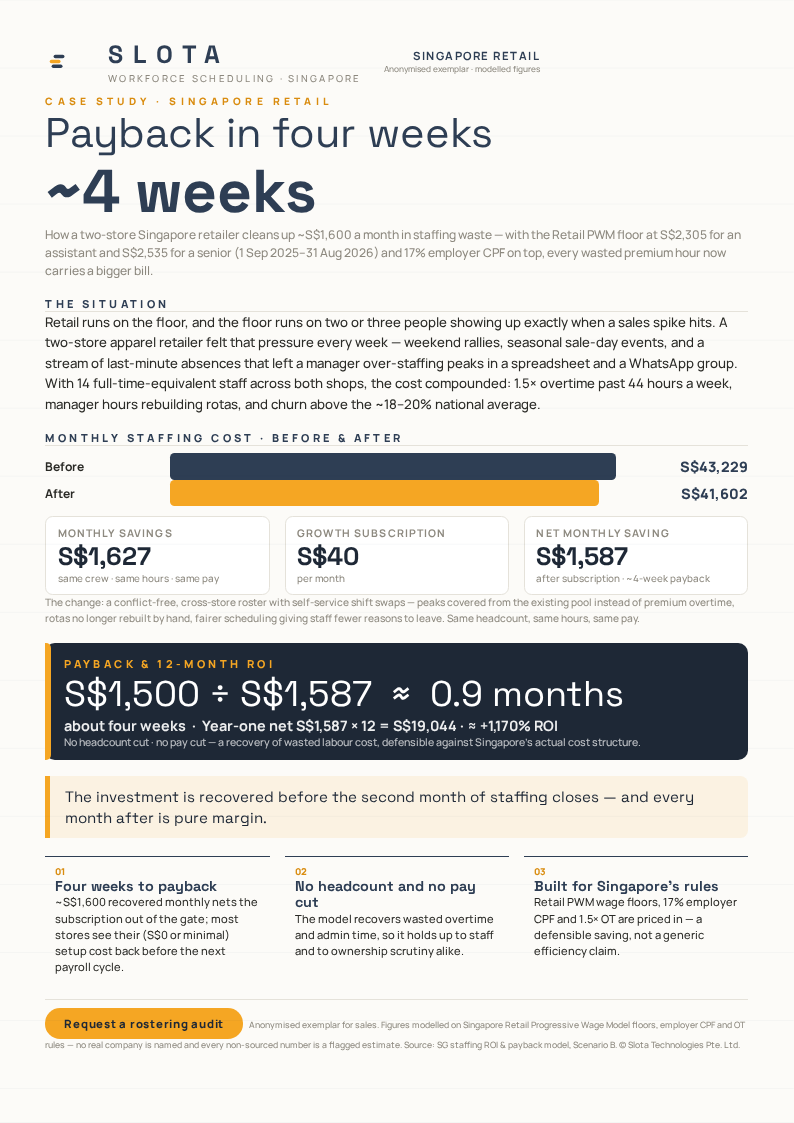
Anonymised, model-based example. Figures are modelled on Singapore Retail Progressive Wage Model floors, employer CPF and OT rules — no real company is named, and every non-sourced number is a flagged estimate (source: our shared Singapore staffing ROI & payback model, Scenario B).
Retail runs on the floor, and the floor runs on two or three people showing up exactly when a sales spike hits. A two-store apparel retailer in Singapore felt that pressure every week: weekend rallies, seasonal sale-day events, and a stream of last-minute absences that left a manager building the rota in a spreadsheet and a WhatsApp group, then over-staffing the peaks so the store was never left short. With 14 full-time-equivalent staff across both shops — supervisors, senior sales and cashiers, and retail assistants — the cost compounded in four places: 1.5× overtime every time a gap was backfilled past 44 hours a week, manager hours spent rebuilding rotas, and replaceable churn in a sector whose turnover runs above the ~18–20% national average.
The affected roles: retail assistants and cashiers on weekend and event shifts — the hardest to cover, the most overtime-exposed, and the first to walk when a rota looks unfair. With the Retail Progressive Wage floor at S$2,305 for an assistant and S$2,535 for a senior (1 Sep 2025–31 Aug 2026), and 17% employer CPF on top, every wasted premium hour now carries a bigger bill.
The before picture. Fully-loaded monthly staffing — base payroll, overtime and fill premium, manager admin, and annualised replacement cost — was S$43,229 a month.
The change. A conflict-free, cross-store roster with self-service shift swaps meant peaks were covered from the existing staff pool instead of premium overtime, rotas stopped being rebuilt by hand, and fairer, predictable scheduling gave employees fewer reasons to leave.
The after picture. The same crew, the same hours, the same headcount and pay — but the waste turned off. Staffing cost dropped to S$41,602 a month.
| Before | After | |
|---|---|---|
| Monthly staffing cost | S$43,229 | S$41,602 |
| Monthly savings | — | S$1,627 |
| Subscription (Growth) | — | S$40 |
| Net monthly saving | — | S$1,587 |
Payback. Setup is S$0 on self-serve signup; even using a conservative S$1,500 assumed onboarding cost, payback is S$1,500 ÷ S$1,587 ≈ 0.9 months — about four weeks.
12-month ROI. Net savings already exclude the subscription: S$1,587 × 12 = S$19,044 in year one, against a S$1,500 upfront = ≈ +1,170% ROI.
Why it matters for a small retailer. The investment is recovered before the second month of staffing closes, and every month after is pure margin. This is not a headcount cut or a pay cut — it is a recovery of wasted labour cost, which for a thin-margin apparel store can be the difference between a profitable and a break-even sales event.
Three things this proves
- Four weeks to payback — ~S$1,600 recovered monthly nets the subscription out of the gate; most stores see their (S$0 or minimal) setup cost back before the next payroll cycle.
- No headcount and no pay reduction — the model recovers wasted overtime and admin time, so it holds up to staff and to ownership scrutiny alike.
- Built for Singapore's rules — Retail PWM wage floors, 17% employer CPF and 1.5× OT are priced in, so the saving is defensible against the actual cost structure, not a generic efficiency claim.
Make the roster the lever, not the leak.
Conflict-proof, PWM-aware rostering across every outlet — set up in minutes.
Get started freeNo credit card · No setup fee